
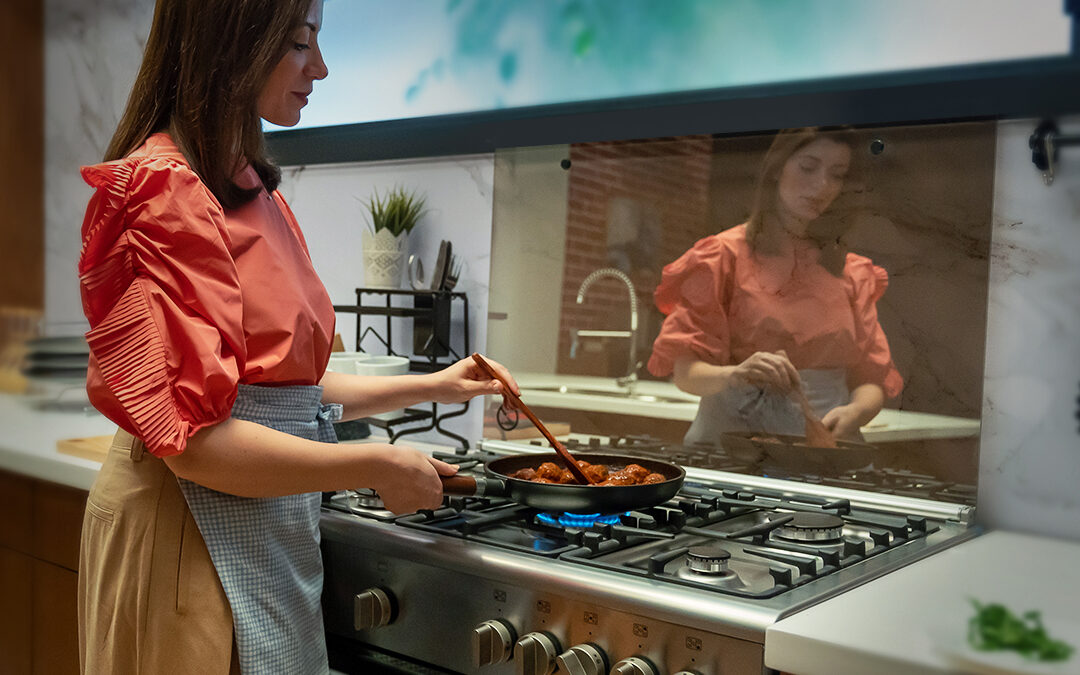
There is something wonderfully reassuring about cooking over a gas flame. Turn the control and the response is almost immediate. You can see the heat, change it in seconds and react to what is happening in the pan. But one of the most useful gas stove cooking tips is also one of the simplest: the biggest flame is not necessarily the best flame.
Good gas cooking is not about turning everything up to maximum and hoping dinner happens more quickly. It is about using enough heat for the job, then adjusting it as the food changes.
Once you understand that, cooking on gas becomes wonderfully intuitive.
In this guide
We look at:
- Why a bigger flame does not always cook food faster
- When to use high, medium and low heat
- How to match your pot or pan to the right burner
- Why flames should remain underneath your cookware
- When to reduce the heat after boiling or searing
- How to make the most of the quick response of a gas stovetop
- Everyday heat settings for onions, eggs, sauces, vegetables and meat
- A few common gas cooking habits that are surprisingly easy to improve
Gas Stove Cooking Tips: Why Bigger Is Not Always Better
It is an understandable instinct.
Dinner is running late, everyone is hungry and the obvious solution appears to be a larger flame.
Except it does not quite work like that.
Once the flame extends beyond the base of your pan and begins curling around the sides, that extra heat is no longer being directed efficiently where you need it.
You may simply be heating the sides of the saucepan, the handles and the surrounding air.
Ideally, the flame should sit beneath the base of the cookware.
There is undeniably something impressive about a large blue flame under a pan, but your dinner does not need the theatre. It just needs the right amount of heat.
What is high heat actually for?
High heat absolutely has a place in the kitchen.
It is particularly useful when you need to build heat quickly, for example:
- Bringing a large pot of water to the boil
- Heating a heavy pan before searing
- Starting certain stir-fries
- Bringing a large quantity of liquid up to temperature
The important part comes next.
Once you have achieved what you needed from that high heat, you can often turn the flame down.
Take pasta water. A strong flame will help bring the pot to the boil, but once the water is bubbling steadily, you generally do not need the burner roaring away at maximum.
Reducing the flame slightly can maintain the boil perfectly well.
It is a small adjustment, but learning to make those adjustments is what gives you real control over gas cooking.
Medium heat: the quiet achiever
Medium heat may not sound particularly exciting, but it probably does more work in the average kitchen than any other setting.
This is where much of everyday cooking happens.
Think:
- Frying onions
- Cooking vegetables
- Making pancakes
- Cooking many egg dishes
- Browning sausages
- Shallow frying
- General pan cooking
Onions are a perfect example.
Turn the heat up too aggressively and the edges can darken before the onions have had time to soften and develop their natural sweetness.
Give them moderate heat and a little patience and they become soft, glossy and golden.
Sometimes the difference between building flavour and burning dinner really is just one small turn of the knob.
Low heat: when patience does the work
Low heat is not simply the setting you use when you are nervous about burning something.
Gentle heat has an important job of its own.
It is particularly useful for:
- Simmering sauces
- Melting butter
- Gently cooking stews
- Cooking delicate egg dishes
- Warming milk
- Finishing certain sauces
- Keeping food warm
A simmer, for example, should look very different from a furious rolling boil.
You are looking for gentle movement and small bubbles rather than the entire contents of the saucepan behaving as though they are trying to make an escape.
This is one of the pleasures of cooking with gas.
If something is getting too lively, turn the control down and the flame responds immediately.
Match the burner to your cookware
One of the easiest gas stove cooking tips to put into practice is simply to look at the size of the pot before choosing the burner.
A small saucepan does not need the largest burner on the stovetop.
Likewise, putting a very large frying pan over a tiny burner may result in slower or less even heating.
The burner should suit the size of the base of your cookware as closely as practical.
Ideally, the flame should heat the bottom of the pan rather than disappearing beyond it.
Think of it as the kitchen equivalent of wearing shoes that actually fit. Bigger is not automatically better.
Watch where the flame is going
Your flame is giving you useful information, so glance underneath the pot occasionally.
If the flame is sitting neatly beneath the base, you are concentrating the heat where it is useful.
If flames are curling up the sides of the saucepan, turn the burner down or consider moving the pot to a smaller burner.
This is especially important when using small cookware.
There is also a practical reason for doing it. Heat travelling unnecessarily up the sides of a saucepan can make handles hotter than they need to be.
A controlled flame is not a timid flame. It is simply one that is doing its job properly.
Learn when to turn the heat down
A recipe may begin over high heat and finish over low heat.
That is perfectly normal.
Cooking is not a matter of selecting one flame setting at the beginning and leaving it there until everything is done.
You might:
- Heat a pan strongly for searing and reduce the flame afterwards
- Bring soup to the boil before lowering it to a simmer
- Preheat a frying pan and then reduce the heat before adding eggs
- Begin vegetables over medium-high heat and finish them more gently
This responsiveness is one of the advantages of cooking over gas.
The food changes as it cooks, and your heat can change with it.
Simple Gas Stove Cooking Tips for Everyday Foods
These gas stove cooking tips are useful starting points for some of the foods we cook most often.
Boiling water
Begin over high heat. Once you have a steady boil, reduce the flame if necessary while maintaining that boil.
Onions
Medium to medium-low heat gives onions time to soften and develop flavour without burning their edges too quickly.
Eggs
Low to medium heat is often more forgiving, particularly for scrambled and fried eggs where control matters more than aggressive heat.
Sauces
Bring the sauce up to temperature and then reduce the heat to a gentle simmer where the recipe calls for it.
Vegetables
Medium to medium-high heat works well for many sautéed vegetables, depending on their size, moisture content and how much colour you want.
Searing meat
A properly heated pan and relatively high heat can help create good surface browning. Once the initial sear is achieved, you may need to adjust the burner according to the cut and cooking method.
Browning tells you what is happening on the outside of meat, not whether it has reached a safe temperature inside. When cooking meat and poultry, a food thermometer is the reliable guide. The USDA Food Safety and Inspection Service safe temperature chart provides guidance on safe minimum internal temperatures.
Soups and stews
Bring them towards a boil, then reduce the heat and allow them to simmer gently.
Let your cookware help you
Your pan plays a part too.
A heavy-based pan will hold and distribute heat differently from a very light one. Cast iron behaves differently from stainless steel. A small saucepan will respond differently from a large stockpot.
That means there is no single magic flame setting that works for everything.
Another of those useful gas stove cooking tips is to become familiar with the cookware you use most often.
After a while, you stop thinking only in terms of “high”, “medium” or “low”.
You start noticing what is actually happening.
The onions are colouring too quickly.
The sauce has stopped simmering.
The pan needs another minute to heat.
That is when cooking starts becoming instinctive rather than mechanical.
If you enjoy different styles of stovetop cooking, our guide to practical La Germania stove accessories also looks at options such as the cast-iron grill and Teppanyaki plate.
Use the control you already have
The beauty of gas is that you can see and change the heat immediately.
Use that responsiveness rather than thinking of the control knob as something you set once and forget about.
If butter is browning too quickly, turn it down.
If a sauce has stopped simmering, give it a little more heat.
If the flame is curling around the sides of the saucepan, reduce it.
If a pan is struggling to get hot enough for a good sear, increase it.
You are not doing anything wrong by changing the temperature while you cook.
Quite the opposite.
You are cooking according to what the food needs.
For more information on different gas and mixed-fuel cooking configurations, you can explore the La Germania appliance range.
The best heat setting is the one your food needs now
Recipes give us useful instructions such as low, medium and high heat, but those words are starting points rather than fixed laws.
The best gas stove cooking tips ultimately come down to watching the pan, watching the flame and responding to what is happening.
Cooking well on gas is not about using as much heat as possible.
It is about knowing when you need more and, just as importantly, knowing when you need less.
Once you get into that habit, something rather lovely happens.
You stop simply turning on the stove.
You start cooking with it.
Quick Gas Stove FAQs
Does a bigger gas flame cook food faster?
Not necessarily. Once the flame extends beyond the base of the cookware, much of the additional heat is no longer being directed efficiently into the pan. Match the flame to the size of the cookware and the cooking job.
Should the flame come up the sides of a saucepan?
Ideally, no. The flame should remain underneath the base. If it is curling around the sides, reduce the heat or use a burner better suited to the size of your saucepan.
What heat should I use to fry onions?
Medium to medium-low heat is generally a good starting point. It allows the onions time to soften and develop flavour without burning too quickly.
What is the difference between boiling and simmering?
Boiling involves vigorous bubbling throughout the liquid. Simmering is much gentler, with smaller bubbles and less movement. Many soups, sauces and stews benefit from simmering rather than boiling continuously.
Which burner should I use for a small saucepan?
Choose a burner that keeps the flame beneath the base of the saucepan rather than extending around the sides. The smallest suitable burner is often a better choice than simply using the largest one.
Should I turn the heat down once water starts boiling?
Usually, yes. Once you have a steady boil, you can often reduce the flame and still maintain it. Keeping the burner unnecessarily high does not make already-boiling water significantly hotter.